
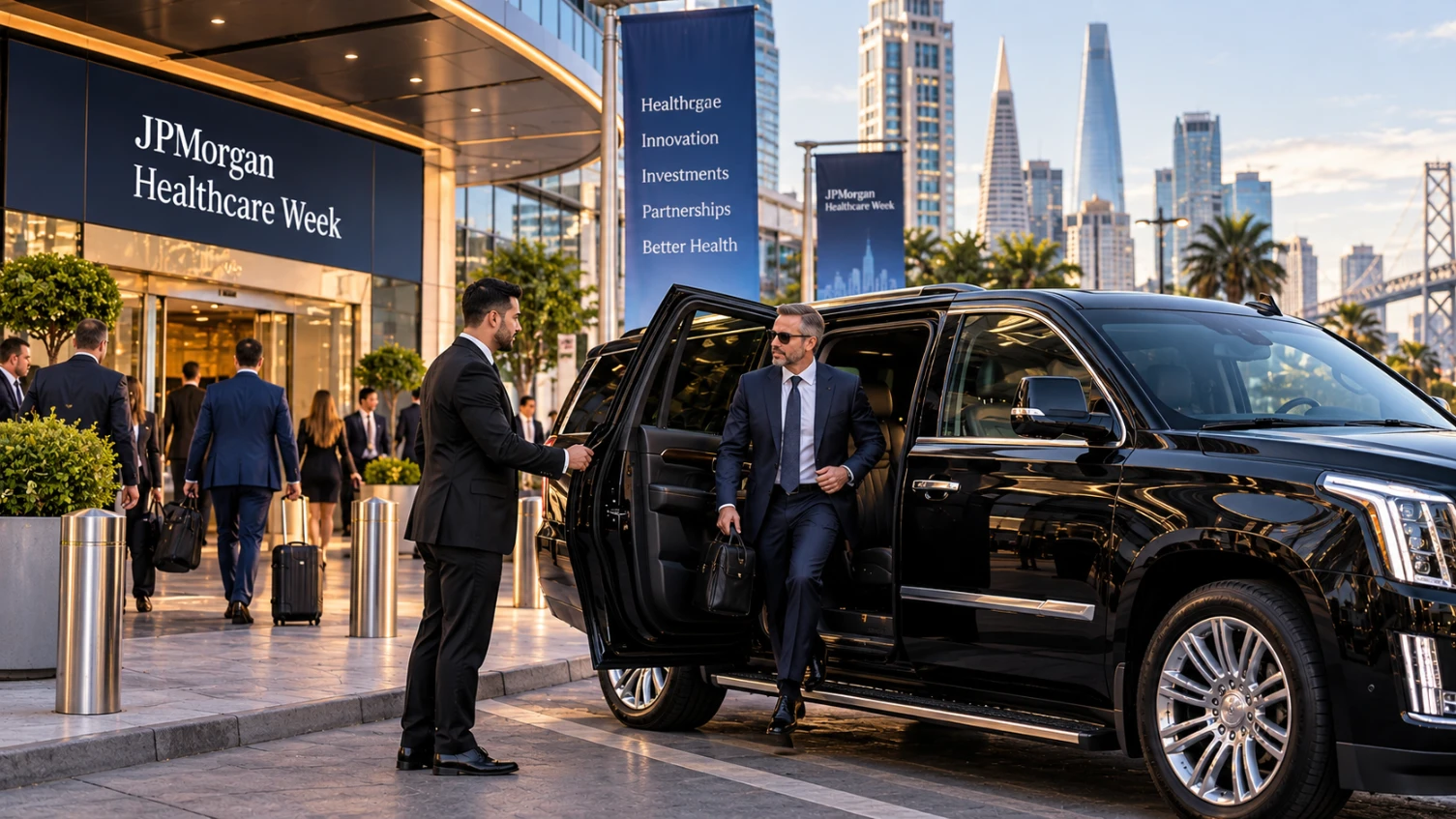
JPMorgan Healthcare Week brings thousands of healthcare executives, investors, physicians, biotech leaders, private equity professionals, and corporate teams to San Francisco for several days of tightly scheduled meetings, presentations, dinners, and private events.
For executive assistants, corporate travel leaders, investor relations teams, event planners, and senior lifestyle managers, transportation during the week is not simply an airport transfer followed by rides between meetings.
An executive may arrive through SFO or a private aviation terminal, move between Union Square, Mission Bay, South San Francisco, Silicon Valley, investor meetings, dinners, and private events, and then depart for another city immediately afterward.
Schedules change constantly. Meetings run long. Investor conversations extend. New meetings are added. Dinner plans shift.
The most effective transportation strategy is therefore to manage the executive’s movements as one coordinated itinerary, supported by centralized oversight, experienced local operations, real-time monitoring, and one point of accountability throughout the week.
When transportation is managed properly, the executive team should not have to think about the individual rides.
They should simply know the next movement is handled.
Why Is Executive Transportation During JPMorgan Healthcare Week So Challenging?
JPMorgan Healthcare Week creates an unusually concentrated executive travel environment across San Francisco and the greater Bay Area.
The challenge is not simply traffic.
Executives may have several time-sensitive commitments in different parts of the region, often with very little flexibility between them.
A typical itinerary can include:
- Commercial airport or private aviation arrivals
- Hotel transfers
- Conference sessions
- Investor and board meetings
- Biotech and healthcare company visits
- Private equity and venture capital meetings
- Roadshows and portfolio company visits
- Executive lunches and dinners
- Corporate hospitality events
- Late-night receptions
- Early-morning departures
A delay in one movement can compress the rest of the day’s schedule.
That makes transportation an operational component of the itinerary rather than a series of independent car reservations.
Plan the Entire Executive Itinerary Before Arrival
The strongest transportation plans begin with the executive’s complete schedule.
Flights, hotels, meetings, dinners, company visits, airport transfers, and departure information should be consolidated into one transportation itinerary before the executive arrives.
The transportation operations team should understand:
- Arrival airport or FBO
- Flight information
- Hotel location
- Meeting addresses
- Expected meeting durations
- Time-sensitive commitments
- Dinner and evening plans
- Passenger and luggage requirements
- Executive preferences
- Security or privacy considerations
- Departure flights and onward travel
The objective is not to predict every detail perfectly.
It is to give the transportation team enough visibility to anticipate what happens next.
Centralize Transportation Instead of Managing Individual Rides
One of the biggest operational risks during JPMorgan Healthcare Week is fragmented transportation.
An airport transfer may be booked with one provider, meetings with another, a dinner car arranged separately, and private aviation transportation handled by yet another contact.
Every additional provider creates another confirmation, communication channel, service standard, and escalation point for the executive’s team to manage.
Centralized executive transportation brings those movements under one operating structure.
For an executive assistant, travel manager, or lifestyle manager, that means:
- One point of contact
- One complete itinerary
- Consistent service standards
- Centralized chauffeur communication
- Real-time visibility across movements
- Proactive schedule adjustments
- 24/7 operational support
- Consolidated billing and reporting
Instead of managing individual rides, the internal team manages one transportation relationship.
The transportation partner manages everything underneath it.
Coordinate Airport and FBO Arrivals With the Full Schedule
The executive’s first movement often sets the tone for the entire week.
Commercial flights should be actively monitored so transportation adjusts to the actual arrival rather than relying solely on the scheduled landing time.
For private aviation, transportation should be coordinated with the appropriate FBO and flight information so the vehicle is positioned according to the passenger’s actual arrival and release.
This is particularly important when the executive is arriving directly into meetings or a dinner shortly after landing.
A flight delay should not require the executive assistant to begin rebuilding the transportation schedule.
The transportation operation should already be adjusting.
Build Realistic Transfer Windows Across San Francisco and the Bay Area
A schedule that looks reasonable on a calendar can become unrealistic once San Francisco and Bay Area traffic are introduced.
Meetings may take executives between Union Square, Mission Bay, South San Francisco, the Financial District, Peninsula communities, and Silicon Valley within the same day.
Transfer windows should account for:
- Time of day
- Traffic patterns
- Event congestion
- Venue access
- Hotel loading
- Passenger readiness
- Weather
- Security requirements
- The importance of the next engagement
The objective is not simply to estimate drive time.
It is to protect the executive’s schedule.
An experienced local operations team should continually evaluate these conditions and adjust departure recommendations when necessary.
Manage Multi-Stop Roadshows as One Continuous Movement
Healthcare and investment executives frequently use conference week for much more than attending the conference itself.
A single day might include an investor breakfast, conference session, biotech company visit, private equity meeting, portfolio company presentation, and executive dinner.
These should not be treated as six unrelated transportation reservations.
They are one continuous executive movement.
The transportation team should understand the complete sequence, position vehicles accordingly, monitor timing throughout the day, and adjust subsequent movements when earlier meetings change.
This is particularly valuable for executives, investment teams, and healthcare leadership groups moving across San Francisco and the Peninsula.
The more complex the itinerary becomes, the more valuable centralized oversight becomes.
Use the Right Transportation Model for the Schedule
Not every executive needs the same transportation structure.
Some schedules are best served by individual point-to-point transfers.
Others require an executive vehicle and chauffeur on hourly standby because meetings are closely spaced or likely to change.
Larger leadership teams may require multiple SUVs, Sprinter-style vehicles, or coordinated group transportation.
The transportation model should reflect:
- Number of passengers
- Meeting frequency
- Schedule flexibility
- Luggage requirements
- Privacy requirements
- Security considerations
- Geographic range
- Expected waiting time
The goal is not to reserve the most expensive vehicle or keep a chauffeur unnecessarily.
It is to design the transportation around the executive’s actual itinerary.
Protect Executive Privacy and Discretion
JPMorgan Healthcare Week brings together senior executives, investors, board members, healthcare leaders, and deal teams during a period when sensitive conversations and confidential meetings are common.
Transportation should support that environment.
Chauffeurs should be professionally vetted, discreet, and familiar with executive service expectations.
Passenger information, itineraries, meeting locations, and travel details should be handled carefully.
For executives discussing acquisitions, investments, financing, partnerships, or other confidential matters, the vehicle is often an extension of the working environment.
Discretion is not an upgrade.
It is part of the service standard.
Monitor the Schedule in Real Time
A transportation itinerary created before the conference begins is only the starting point.
JPMorgan Healthcare Week is dynamic.
Meetings run over. Investor conversations continue. Locations change. New appointments appear. Evening plans evolve.
Real-time transportation oversight allows the operation to adjust around those changes.
If a meeting runs 30 minutes late, the next movement should already be reviewed.
If the executive’s next meeting changes locations, routing and vehicle positioning should adjust.
If an evening dinner extends, the chauffeur schedule should adapt without requiring the executive to manage it.
This is where live operational support creates its greatest value.
The transportation team should be watching the schedule so the executive team does not have to watch the transportation.
Plan Late-Night and Early-Morning Movements in Advance
Conference days often begin early and extend well into the evening.
Executive dinners, receptions, networking events, and private meetings can continue late, while departures may begin again early the following morning.
Late-night returns and early airport or FBO transfers should therefore be incorporated into the transportation plan before the week begins.
The executive assistant or travel manager should know that operational support remains available when schedules change outside normal business hours.
For a major executive travel week, 24/7 support is not simply convenient.
It protects continuity.
Coordinate Multiple Executives and Leadership Teams Centrally
Many companies send more than one executive to JPMorgan Healthcare Week.
CEOs, CFOs, business development leaders, investor relations teams, board members, physicians, and other senior leaders may all have separate schedules operating simultaneously.
Managing those movements individually creates unnecessary complexity.
Centralized transportation coordination can provide visibility across the entire executive group while maintaining separate itineraries for each traveler.
That allows the transportation team to coordinate:
- Simultaneous airport arrivals
- Separate executive schedules
- Multi-vehicle movements
- Group meetings and dinners
- Vehicle repositioning
- Last-minute itinerary changes
- Coordinated departures
For executive assistants and corporate travel teams supporting multiple leaders, this can significantly reduce the amount of transportation management required throughout the week.
Extend the Coordination Beyond San Francisco
For many executives, JPMorgan Healthcare Week is only one segment of a larger business itinerary.
A principal may arrive from New York, London, Boston, Chicago, or another market and depart San Francisco directly for the next meeting or event.
A global executive transportation partner can coordinate those movements under the same operational structure.
That means the executive’s airport transfer in the next city does not become another provider for the assistant to source, brief, and monitor.
The transportation itinerary continues.
For multi-city and international executive travel, this continuity can save significant administrative time while maintaining consistent standards across locations and time zones.
What Should You Look for in an Executive Transportation Partner?
During a high-demand business event, vehicle availability alone is not enough.
Executive assistants, corporate travel leaders, and event teams should evaluate whether the transportation partner can provide:
- Experienced executive chauffeurs
- Local operational expertise
- Airport and FBO coordination
- Flight tracking
- Real-time itinerary monitoring
- Multi-stop and multi-vehicle coordination
- 24/7 live operational support
- Clear escalation procedures
- Consistent service standards
- Multi-city and international coverage
- Centralized billing and reporting
- One point of accountability
The most important question is simple:
When something changes, who takes ownership?
A strong executive transportation partner should already have the answer.
JPMorgan Transportation Frequently Asked Questions
How far in advance should executive transportation be booked for JPMorgan Healthcare Week?
Transportation should be arranged as early as practical once the executive’s attendance and preliminary schedule are known. High-demand vehicles, experienced chauffeurs, and multi-day transportation capacity become more limited as conference week approaches, particularly for complex executive and group itineraries.
Should an executive use one dedicated chauffeur throughout JPMorgan Healthcare Week?
It depends on the itinerary. Executives with dense schedules, multiple daily meetings, or frequent schedule changes may benefit from an hourly or dedicated chauffeur arrangement. Simpler schedules may be managed efficiently through coordinated point-to-point transportation. The transportation model should be designed around the schedule rather than applied universally.
Can one transportation partner manage multiple executives with different schedules?
Yes. Centralized transportation coordination allows separate executive itineraries to operate simultaneously under one transportation program, giving executive assistants and corporate travel teams visibility and one point of accountability across the entire group.
Can executive transportation coordinate private aviation arrivals?
Yes. Private aviation transportation can be coordinated with the appropriate FBO, flight information, and passenger requirements so the vehicle is positioned around the aircraft’s actual arrival and the executive’s onward schedule.
What happens when meetings run late or locations change?
With real-time operational monitoring, subsequent movements can be adjusted around the revised schedule. Chauffeur positioning, pickup times, routing, and later movements can be updated without requiring the executive or assistant to rebuild each reservation individually.
Why is centralized transportation important during JPMorgan Healthcare Week?
Centralized coordination brings airport transfers, meetings, roadshows, dinners, private aviation, and departures under one operating structure. This gives executive assistants and travel teams consistent standards, real-time visibility, one communication channel, and one point of accountability throughout the week.
Can the same transportation partner manage the executive’s next destination?
Yes. A nationwide or global executive transportation partner can continue coordinating the itinerary beyond San Francisco, maintaining the same communication structure and service standards as the executive moves between cities or countries.
Conclusion
Executive transportation during JPMorgan Healthcare Week is ultimately about protecting time, maintaining continuity, and reducing operational friction during one of the most important business weeks in healthcare and investment.
For executive assistants, corporate travel leaders, investor relations teams, event planners, and lifestyle managers, the transportation should not become another schedule that requires constant supervision.
Airport arrivals, FBO transfers, investor meetings, roadshows, dinners, late-night changes, departures, and onward travel should operate within one coordinated transportation structure.
With centralized oversight, experienced local execution, real-time monitoring, and 24/7 operational support, the transportation adapts as the executive’s schedule changes.
The executive focuses on the meetings. The internal team focuses on the business. The transportation is already being managed.
