
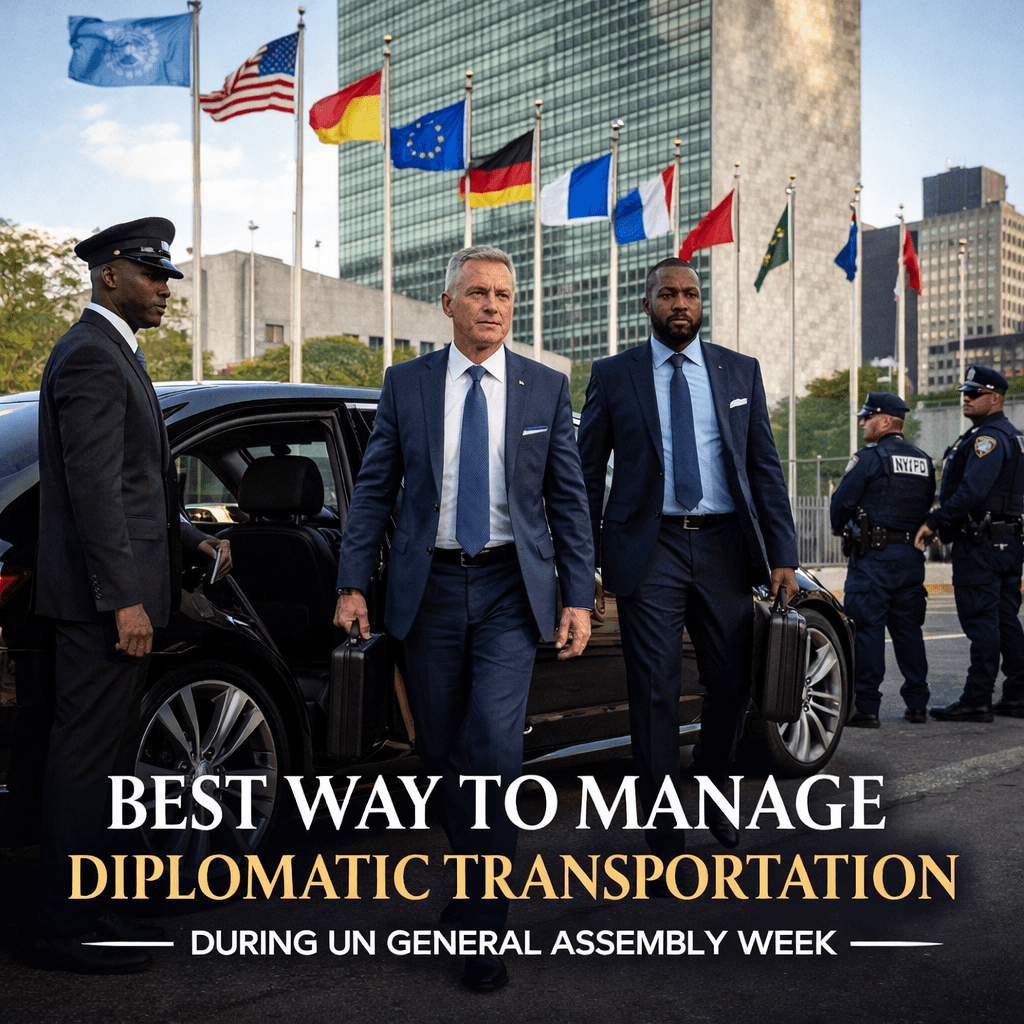
Each September, New York City hosts one of the most complex diplomatic gatherings in the world: the United Nations General Assembly (UNGA). Heads of state, foreign ministers, diplomatic delegations, international organizations, and global business leaders converge in Manhattan for a week of high-level meetings, policy discussions, and private engagements.
For senior lifestyle managers, diplomatic protocol teams, executive assistants, corporate travel leaders, and personal assistants supporting high-profile principals, public-facing executives, and media-facing leadership, transportation during UNGA week cannot be treated as a routine booking. It must be carefully integrated into the operational structure surrounding the event.
Street closures, layered security zones, motorcade activity, and international arrivals create a highly dynamic transportation environment. During this period, moving from one engagement to another reliably and discreetly becomes a mission-critical function.
The UNGA Environment and What It Means for Transportation
This is not standard city travel. It is high-visibility, security-sensitive coordination where precision, discretion, and execution directly impact schedules, perception, and control.
Whether supporting diplomatic delegations, international executives, policy leaders, or private principals attending UNGA meetings, transportation must be built into the broader operational plan from the outset, not arranged reactively during the week itself.
United Nations General Assembly week transforms large areas of Midtown Manhattan into a tightly controlled security zone. The area surrounding the United Nations Headquarters, particularly along First Avenue and East 42nd Street, experiences extensive traffic restrictions, road closures, and controlled access points.
At the same time, international delegations arrive through major regional airports while attending meetings throughout the city. Common destinations include:
- United Nations Headquarters
- Midtown diplomatic missions and consulates
- International organization offices
- Major hotels hosting delegations
- Private diplomatic receptions and policy forums
This creates a transportation environment where movements must be coordinated carefully within a city already operating under heavy restrictions.
For planners managing diplomatic or executive travel during UNGA week, understanding these conditions is essential. Transportation must function as a structured operational system rather than a sequence of independent reservations.
1. Plan Around Diplomatic Schedules and Movement Windows
During UNGA week, principals often maintain extremely tight schedules involving multiple engagements across Manhattan. Transportation planning should align with the entire itinerary rather than individual trips. Key movement milestones often include:
- International airport arrivals
- Hotel check-ins and security processing
- United Nations meeting schedules
- Bilateral diplomatic meetings
- Policy forums and speaking engagements
- Private receptions or dinners
Because many engagements are time-sensitive and coordinated with other delegations, delays can affect entire meeting schedules. Transportation must therefore support the broader diplomatic timetable rather than interrupt it.
For example, a diplomatic principal attending UNGA events may:
- Arrive on an international flight
- Attend a meeting at the United Nations
- Participate in a bilateral discussion at a diplomatic mission
- Attend an evening policy forum
- Return to a hotel or attend a private diplomatic reception
Mapping transportation around this sequence ensures each movement occurs smoothly within the larger schedule.
2. Account for Security Zones and Street Closures
UNGA week involves one of the most extensive security operations in New York City each year.
Transportation planning must account for:
- Road closures near the United Nations complex
- Security checkpoints along First Avenue and surrounding streets
- Temporary traffic restrictions during motorcades
- Controlled vehicle access points
These restrictions change throughout the day depending on diplomatic movements and security operations.
Advance coordination with building security teams, event organizers, and hotel staff helps ensure arrival routes and pickup locations remain viable under evolving conditions.
Operating with known access strategies allows movements to remain predictable even during heavy security operations.
3. Maintain Centralized Coordination for All Movements
Fragmented transportation arrangements introduce avoidable operational risk during a high-security event like UNGA.
Instead of managing individual reservations independently, effective planning relies on centralized oversight across all movements.
Centralized coordination typically includes:
- A single operational point managing transportation schedules
- Continuous communication with chauffeurs and operations teams
- Real-time visibility into all active movements
- Consistent protocols for arrivals, departures, and adjustments
This structure ensures that each movement remains aligned with the principal’s broader schedule.
For executive assistants and diplomatic coordinators, centralized oversight provides clarity and control without requiring constant manual supervision.
4. Build Buffer Strategy Into Every Schedule
During UNGA week, Midtown Manhattan experiences unusually heavy traffic conditions. Diplomatic motorcades, security perimeters, and road closures can quickly alter travel times.
To maintain schedule reliability, vip transportation plans should incorporate intentional buffers. These buffers should account for:
- Security screening at building entrances
- Street closures or rerouted traffic
- Diplomatic motorcade activity
- Elevator access delays in large hotels or conference venues
For high-profile principals, even minor delays can become visible disruptions. Even small delays can cascade into missed meetings when schedules are tightly coordinated between multiple delegations.
A structured buffer strategy protects both timing and reputation for high-profile clients.
5. Establish Clear Communication With Principals and Assistants
While transportation coordination may involve significant operational complexity, communication should remain clear, concise, and discreet.
Effective communication protocols include:
- Confirmed departure windows
- Clearly identified meeting points
- Contact information for operational support
- Real-time updates when adjustments occur
During UNGA week, principals often move quickly between engagements with limited time for logistical coordination. Providing clear instructions reduces confusion while maintaining discretion and efficiency.
6. Leverage Local Knowledge of Midtown Operations
Local operational expertise is particularly important during UNGA week and it’s one of the key benefits of choosing a VIP black car service for corporate travel. Transportation teams familiar with Midtown Manhattan understand factors such as:
- Typical traffic rerouting patterns near the United Nations complex
- Hotel loading zone constraints
- Optimal pickup points near major diplomatic venues
- Traffic flow changes during motorcade movements
These variables are often invisible on navigation platforms but significantly affect real-world movement. Local knowledge allows planners to anticipate challenges and build reliable routes accordingly.
7. Monitor Real-Time Conditions Continuously
Because traffic patterns during UNGA week change rapidly, transportation operations must rely on continuous monitoring rather than static schedules.
Real-time monitoring may include:
- Flight tracking for international arrivals
- Traffic updates across Midtown corridors
- Live communication with chauffeurs
- Immediate route adjustments when needed
This level of oversight ensures movements remain controlled even when conditions shift unexpectedly. Continuous monitoring helps maintain reliability in a highly dynamic environment.
8. Coordinate Multiple Clients or Delegations Under One Structure
Lifestyle managers and diplomatic coordinators often manage transportation for several principals or delegations simultaneously during UNGA week.
Centralized scheduling transforms complex, multi-principal coordination into a controlled system by allowing planners to:
- Track multiple movements within a unified system
- Coordinate arrival sequences across different venues
- Maintain consistent communication protocols
- Ensure that all principals receive the same operational standard
This approach reduces fragmentation while preserving visibility across every scheduled movement.
9. Prepare Escalation Procedures for Unexpected Changes
Despite careful planning, UNGA week inevitably introduces unexpected developments such as:
- Schedule changes from diplomatic offices
- Extended meetings at the United Nations
- Sudden security adjustments
- Weather disruptions affecting arrivals
Transportation planning should include a clear escalation structure to address these issues efficiently.
This structure typically involves:
- Defined operational decision points
- Direct access to senior coordination support
- Preplanned alternate routes
- Immediate communication with assistants or protocol staff
Well-structured escalation procedures allow planners to absorb disruptions quietly while preserving schedule stability.
10. Secure Transportation Capacity Well in Advance
Demand for transportation during UNGA week increases significantly due to the presence of international delegations, global executives, media teams, and policy organizations.
Securing transportation capacity early allows planners to:
- Confirm operational oversight
- Coordinate schedules across multiple engagements
- Establish contingency planning
- Ensure reliable coverage during peak demand periods
Early planning helps prevent last-minute challenges during one of the busiest diplomatic weeks in New York City.
Conclusion
Managing diplomatic and executive transportation during United Nations General Assembly week requires more than arranging city travel- it requires structured operational control.
For senior lifestyle managers, diplomatic protocol teams, executive assistants, and corporate travel leaders, transportation must function as a centralized, continuously monitored system- not a series of reactive movements.
When properly structured, transportation operates with predictability, discretion, and consistency, even within one of the most complex environments in New York City.
This allows principals, executives, and delegations to move seamlessly between engagements, while the complexity of coordination remains fully managed behind the scenes.
