
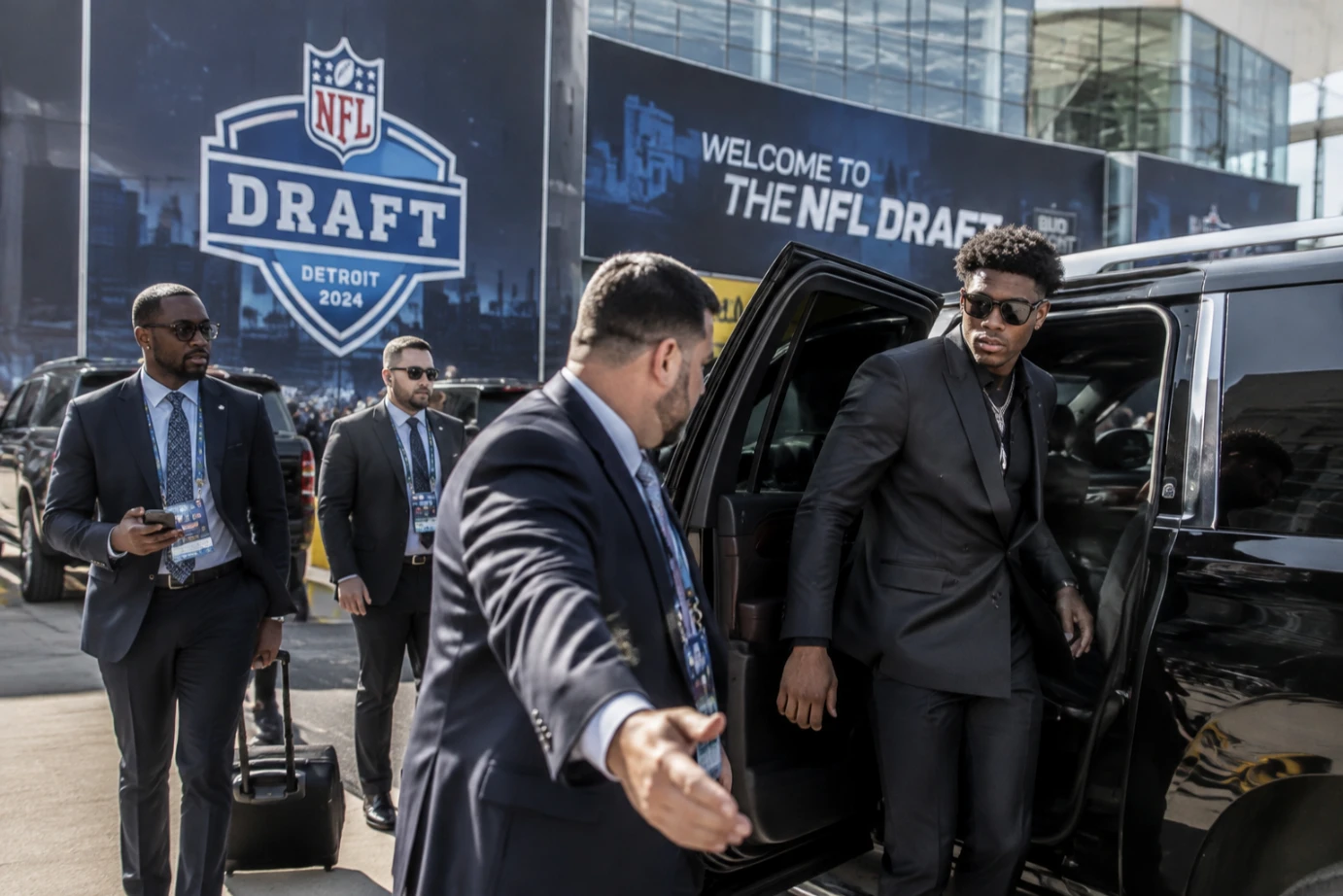
NFL Draft week is one of the most important and unpredictable moments in an athlete’s career.
For athlete business managers, agents, publicists, and family offices supporting a prospect, the transportation challenge extends far beyond getting the athlete to the Draft.
The athlete, family members, agent, publicist, security team, media representatives, and other members of the travel party may all have different schedules. Flights change. Interviews are added. Sponsor obligations move. Events run late. And once the athlete is selected, the next destination and schedule can change almost immediately.
That is why NFL Draft transportation should be managed as one coordinated operation rather than a collection of individual rides.
With centralized oversight, real-time monitoring, experienced local execution, and one point of accountability, the athlete’s team can focus on the career moment while the VIP transportation adapts around them.
Why Is NFL Draft Transportation So Complex?
Draft week combines high visibility with an unusually dynamic schedule.
Before the Draft, the athlete may have media appearances, sponsor commitments, meetings, rehearsals, dinners, and private events.
At the same time, family members and representatives may be arriving on different flights and staying on different schedules.
Then the athlete is selected.
Suddenly, the itinerary may change again.
Transportation planning may need to accommodate:
- Commercial or private aviation arrivals
- Airport and FBO transfers
- Family and Athlete transportation
- Agent and business manager movements
- Publicist and media schedules
- Sponsor appearances
- Draft-related events
- Security requirements
- Hotels and private events
- Post-selection media commitments
- Family departures
- Onward travel following the Draft
The challenge is not predicting exactly what will happen.
It is creating a transportation operation capable of adapting when it does.
Start With the Complete Draft Week Itinerary
The strongest NFL Draft transportation plans begin with the entire week rather than individual reservations.
Before the athlete arrives, the transportation team should understand:
- Athlete arrival information
- Family and guest arrivals
- Hotel locations
- Draft-related commitments
- Media appearances
- Sponsor obligations
- Private events and dinners
- Security requirements
- Expected departure plans
- Potential onward travel after the Draft
The itinerary will almost certainly change.
That makes centralized visibility even more important.
When the transportation team understands the full schedule, one change can be evaluated against
everything that follows rather than treated as an isolated ride adjustment.
Coordinate the Athlete, Family, and Representation Separately
One of the most important principles of NFL Draft transportation planning is recognizing that the athlete’s travel party does not necessarily move as one group.
The athlete may need to leave for a media commitment while family members remain at the hotel.
The agent may have separate meetings.
The publicist may need to reach another venue before the athlete arrives.
Security personnel may have their own positioning requirements.
Family members may also arrive and depart on different schedules.
Transportation should therefore be structured around individual movement requirements while remaining centrally coordinated.
This provides each traveler with the flexibility they need without fragmenting the overall operation.
Centralize Transportation Across the Entire Travel Party
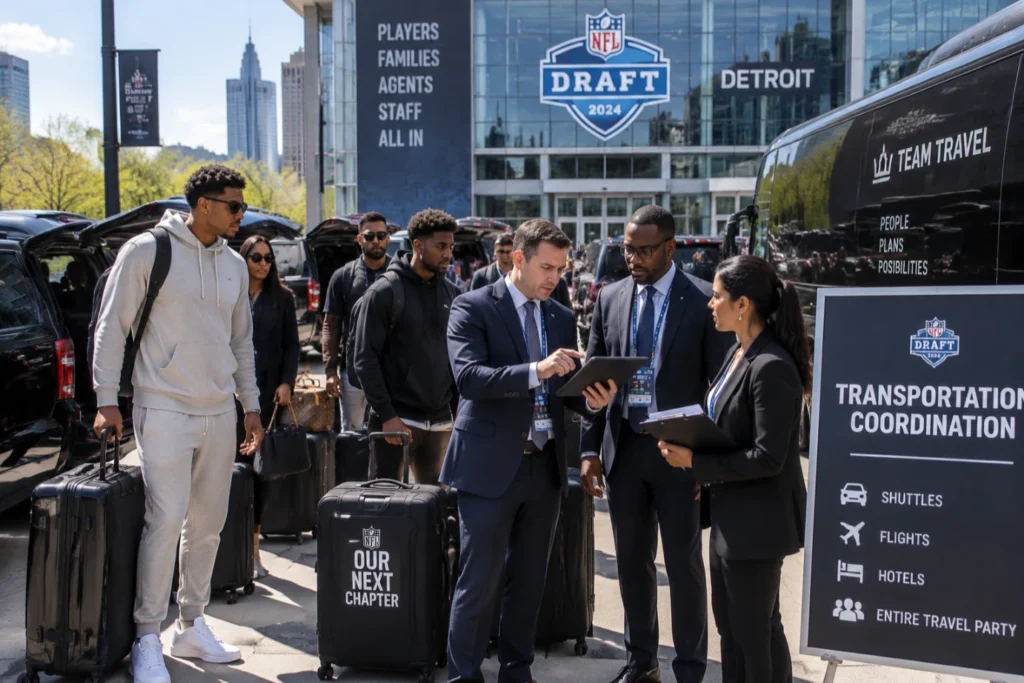
Managing each person through separate transportation providers creates unnecessary complexity during an already unpredictable week.
Centralized transportation coordination gives the athlete’s business manager or representative one point of accountability across the entire travel party.
That can include:
- Athlete transportation
- Family transportation
- Agent and business manager movements
- Publicist and media transportation
- Security coordination
- Airport and FBO transfers
- Sponsor appearances
- Event transportation
- Late-night schedule changes
- Departures and onward travel
Instead of managing multiple chauffeurs, confirmations, and providers, the athlete’s team communicates through one transportation structure.
The transportation operation manages everything underneath it.
Build the Plan Around the Most Time-Sensitive Commitments
Not every movement during Draft week carries the same operational importance.
Certain commitments may have very little flexibility, while others can move as the schedule evolves.
The transportation plan should identify the most time-sensitive movements first and build appropriate buffers and vehicle positioning around them.
Rather than relying on a universal time buffer, planning should account for:
- Distance
- Traffic conditions
- Venue access
- Security
- Passenger readiness
- Media requirements
- Event schedules
- The consequences of arriving late
The objective is to protect the athlete’s schedule without creating unnecessary waiting.
Use the Right Transportation Model for Each Traveler
The athlete, family, agent, publicist, and support team may require different transportation solutions.
An athlete with a dense schedule may benefit from a dedicated chauffeur and vehicle on standby.
Family members may require an SUV or Sprinter-style vehicle depending on group size and luggage.
Agents, publicists, and business managers may need independent vehicles because their schedules frequently diverge from the athlete’s.
The right transportation model depends on the actual movement rather than a predetermined vehicle type.
The goal is flexibility without fragmentation.
Brief Chauffeurs and Operations Teams on the Principal
NFL Draft transportation requires a higher level of preparation than an ordinary point-to-point transfer.
The transportation team should understand:
- Who the principal is
- Who is authorized to travel with them
- Privacy expectations
- Communication protocols
- Security requirements
- Preferred pickup procedures
- Venue access information
- Passenger preferences
- Escalation contacts
For high-profile athletes, discretion should be part of the operating standard. Passenger information, schedules, pickup locations, and travel details should be handled carefully.
The chauffeur should understand the movement.
The operations team should understand the entire context around it.
Coordinate Airport and FBO Arrivals in Real Time
Athletes, family members, agents, and other members of the travel party may arrive at different times and through different airports or private aviation facilities.
Commercial flights should be actively monitored so transportation adjusts to actual arrival times.
Private aviation transportation should be coordinated around aircraft timing, FBO procedures, passenger release, and the traveler’s onward schedule.
If a flight is delayed, the transportation operation should already be adjusting.
The athlete’s business manager should not have to start calling chauffeurs every time an arrival changes.
Manage Schedule Changes as They Happen
Draft week schedules are inherently dynamic.
Media appearances move.
Sponsor commitments are added.
Meetings run late.
Dinner plans change.
Family members adjust their schedules.
The transportation operation needs to respond in real time.
When one commitment changes, subsequent movements should be reviewed and adjusted proactively.
That may mean repositioning a vehicle, changing a pickup time, coordinating another chauffeur, or modifying the next airport transfer.
The athlete’s team should not have to rebuild the transportation plan every time something changes.
That is the value of centralized operational oversight.
Plan Beyond Draft Night
One of the strongest points in the original planning concept is also one of the most important: Draft night is not the end of the transportation operation.
Once the athlete is selected, a new series of commitments may begin.
There may be media obligations, team-related travel, sponsor appearances, family movements, airport transfers, and onward travel that were impossible to finalize before the selection occurred.
The transportation partner should therefore remain engaged through the athlete’s and travel party’s final departures.
The stage moment is a milestone.
It is not the end of the itinerary.
Coordinate Onward Travel as Part of the Same Operation
For the athlete, the Draft host city may only be one part of a rapidly changing itinerary.
Once selected, the athlete may need to travel to another city for team activities, media obligations, meetings, or other commitments.
A nationwide or global executive transportation partner can continue managing ground transportation at the next destination under the same operational structure.
That means the business manager does not need to begin sourcing another transportation company while simultaneously managing everything else happening after the Draft.
The transportation follows the athlete.
Why 24/7 Live Support Matters During Draft Week
NFL Draft schedules do not operate within normal business hours.
Flights arrive late. Events continue into the evening. Media schedules change. Family members need transportation at different times. Post-selection plans may develop quickly.
Someone needs to remain accountable throughout the process.
A 24/7 transportation operations team can monitor active movements, communicate with chauffeurs, adjust schedules, coordinate new transportation requirements, and manage disruptions as they occur.
For the athlete’s business manager, agent, or publicist, this reduces one of the biggest burdens of Draft week:
having to personally manage every transportation change.
Protect Privacy and Coordinate With Security
NFL Draft prospects can attract significant public and media attention.
Transportation planning should therefore account for privacy, discretion, and any security requirements established by the athlete’s team.
When executive protection or personal security is involved, the transportation operation may need to coordinate:
- Vehicle requirements
- Chauffeur information
- Routing
- Staging
- Pickup procedures
- Passenger manifests
- Communication protocols
- Backup plans
Transportation and security should operate within the same broader movement plan rather than as disconnected functions.
Common NFL Draft Transportation Planning Mistakes
Even experienced teams can create unnecessary risk when transportation is treated as a collection of individual bookings.
Common mistakes include:
- Waiting too long to secure transportation
- Treating the athlete and family as one travel group
- Booking each movement independently
- Leaving insufficient flexibility between commitments
- Failing to monitor flight changes
- Not planning for late-night schedule adjustments
- Underestimating post-selection transportation needs
- Failing to establish clear escalation procedures
- Ending transportation planning at Draft night
- Using different providers without centralized oversight
The common thread is fragmentation.
The more dynamic the schedule becomes, the more important centralized coordination becomes.
What Should Athlete Business Managers Look for in an NFL Draft Transportation Partner?
Vehicle quality matters, but it should be expected.
The more important questions are operational.
Can the transportation partner provide:
- Professionally vetted chauffeurs
- Experience with high-profile travelers
- Airport and FBO coordination
- Real-time flight monitoring
- Multiple vehicle and passenger coordination
- Athlete and family transportation
- Privacy and discretion protocols
- Security coordination when required
- Real-time itinerary monitoring
- 24/7 live operational support
- Nationwide coverage for onward travel
- Clear escalation procedures
- One point of accountability
The most important question is not:
What vehicle will you send?
It is:
Who is managing everything when the schedule changes?
Frequently Asked Questions
How early should athlete transportation be arranged for the NFL Draft?
Transportation planning should begin as soon as the athlete’s Draft attendance and preliminary travel schedule are known. Earlier planning provides more flexibility for coordinating the athlete, family members, representatives, airport transfers, vehicle requirements, and changing event schedules.
Should the athlete and family use the same transportation?
Not necessarily. Athletes, family members, agents, publicists, and security teams often have different schedules during Draft week. Separate vehicles can provide greater flexibility while centralized oversight keeps all movements coordinated under one plan.
What type of vehicle is best for NFL Draft transportation?
The right vehicle depends on the traveler and movement. Executive sedans and SUVs may be appropriate for athletes and representatives, while larger SUVs or Sprinter-style vehicles can accommodate families and larger groups. Vehicle selection should reflect passenger count, luggage, privacy, security, and schedule requirements.
Can transportation coordinate private aviation and FBO transfers?
Yes. Private aviation transportation can be coordinated around flight information, FBO procedures, passenger release, vehicle staging, and the athlete’s onward itinerary.
What happens when the athlete’s schedule changes?
With real-time operational oversight, chauffeur positioning, pickup times, vehicles, and subsequent movements can be adjusted around the revised itinerary. The goal is to manage the change without requiring the athlete’s business manager to rebuild each reservation individually.
Can one transportation partner manage the athlete, family, agent, and publicist?
Yes. Centralized transportation coordination allows each traveler’s movements to remain separate while operating under one transportation structure. This gives the business manager one point of accountability and visibility across the complete travel party.
What happens after the athlete is selected?
Transportation planning should continue beyond Draft night. Post-selection requirements may include media appearances, team-related travel, sponsor obligations, family departures, airport transfers, and onward transportation to another city.
Can the same transportation partner manage the athlete’s next destination?
Yes. A nationwide or global transportation partner can continue coordinating ground transportation as the athlete moves to another city, maintaining the same communication structure, service standards, and operational oversight.
Why is 24/7 support important during NFL Draft week?
Draft week includes late-night events, changing schedules, flight delays, and post-selection travel that can develop outside normal business hours. Live 24/7 operational support ensures transportation changes can be addressed immediately without shifting the responsibility back to the athlete’s team.
Conclusion
NFL Draft transportation is ultimately about protecting one of the most important weeks of an athlete’s career from unnecessary operational distractions.
For athlete business managers, agents, publicists, and family offices, the value is not simply having a professional chauffeur waiting outside.
It is knowing that the athlete, family, representatives, airport movements, media commitments, schedule changes, security requirements, and onward travel are being managed through one accountable transportation operation.
With advance planning, centralized oversight, real-time monitoring, and 24/7 operational support, the transportation can adapt as Draft week unfolds.
The athlete should be focused on the moment.
The family should be able to experience it.
The business manager should be managing the athlete’s career, not chasing cars.
The transportation is already handled.
